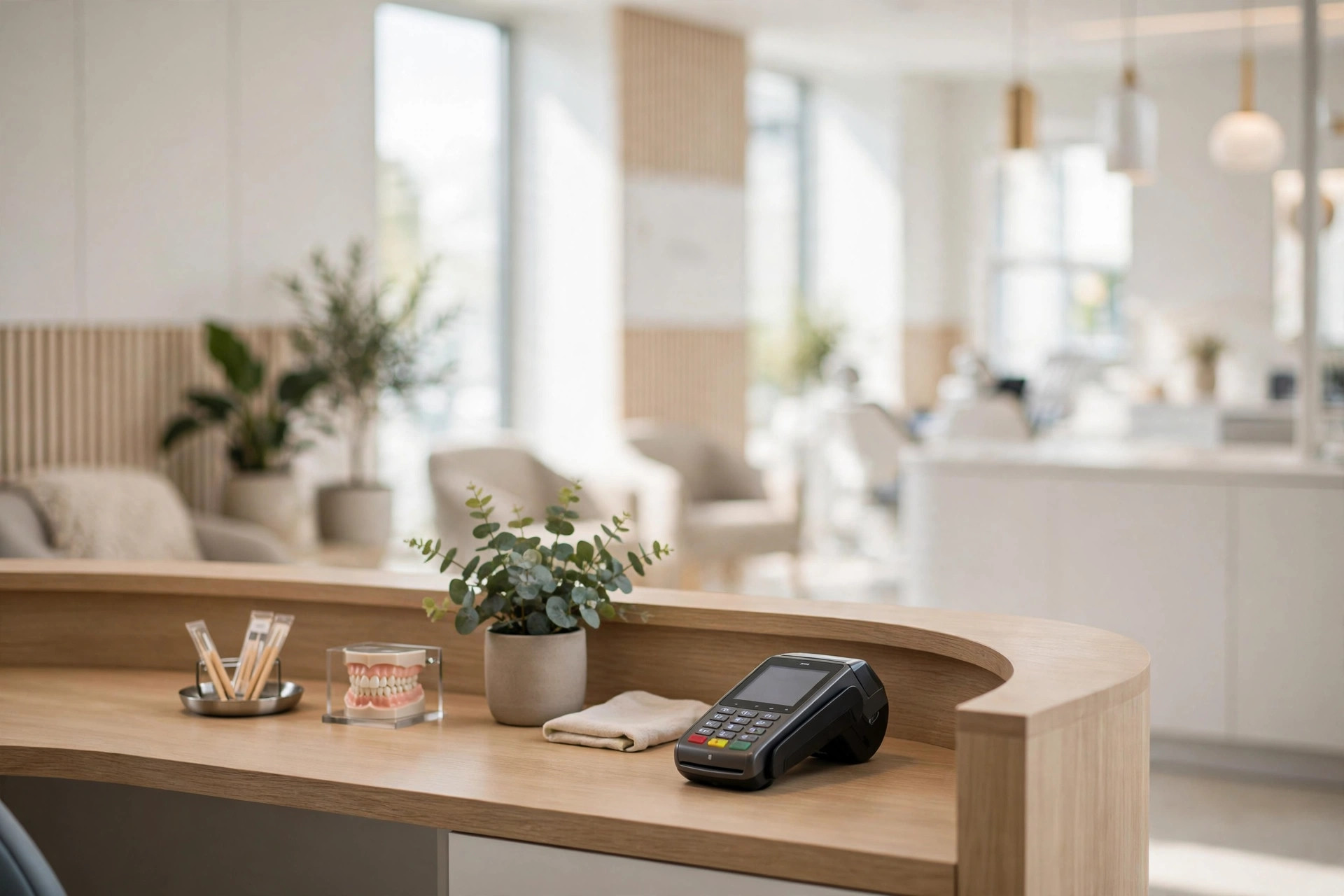
A dental clinic doesn't take payments like a store. The patient gets treatment, the insurance claim goes in, the insurer pays part, and the patient owes the rest, sometimes weeks later, sometimes by email link, sometimes split across two cards. That mix is exactly where processing fees hide: Canadian dental guides put Visa and Mastercard at roughly 1.4% to 2.9% and Interac debit at $0.05 to $0.25 per tap, but a clinic pays all three at once, on different terms.
Why dental payments cost differently: split billing, delayed payment, and the online surcharge
Three features of dental billing push fees above what a retailer pays on the same volume:
| Feature | What happens | Fee effect |
|---|---|---|
| Split billing | Insurer pays part, patient pays the balance, often on a different card, later | Two transactions (two per-transaction fees) instead of one |
| Payment links | Post-visit balances collected by email or SMS link | Card-not-present rates run higher than in-person, online interchange sits above chip/tap |
| Pre-authorizations | Holds placed for large procedures before treatment | Holds that settle late can downgrade to higher interchange if the data goes stale |
Canadian interchange spans roughly 0.92% to 2.4% depending on card type and channel, with total processing typically landing between 1% and 3%. The clinic's job is to keep as much of its volume as possible at the bottom of that band.
Worked math: a clinic at $60,000/month, worked three ways
The setup: $60,000/month in card volume. Mix: $30,000 card-present credit at the front desk (procedures), $18,000 via online payment links (card-not-present), $12,000 Interac debit for small balances. About 500 transactions total (~$120 average).
Flat-rate at 2.65% + $0.10/transaction: $60,000 × 2.65% = $1,590, plus 500 × $0.10 = $50. Total: ~$1,640/month (2.73% effective). Note what's happening: the $12,000 in debit is billed at 2.65% ($318) when the wholesale cost is about eight cents a tap.
Interchange-plus at wholesale + 0.40% + $0.10/transaction: wholesale on the mix runs near 1.50% (~$900), markup 0.40% (~$240), per-transaction ~$50, debit ~$12. Total: ~$1,202/month (2.00% effective).
Same, plus debit steering: small balances under $250 are steered to Interac at the front desk (debit share rises to $20,000). Total: ~$1,090/month, another ~$110/month saved, roughly $1,300 a year, from one front-desk habit.
The gap: flat-rate costs ~$550/month more than steered interchange-plus, about $6,600 a year. Assumptions are stated above; your mix moves the numbers, not the ranking.
Processor comparison with dated Canadian pricing
| Processor | Published Canadian pricing (checked) | Dental fit |
|---|---|---|
| Helcim | Interchange-plus, ~0.40% in-person margin over interchange (checked 2026-10-11) | Best for clinics over ~$25k/month; payment links and invoicing built in |
| Square | 2.50% in-person credit, Canada (checked 2026-10-11) | Simple for small clinics; online rate runs 2.80% + 30¢, which stings on payment-link volume |
| Moneris | Flat rate from 2.65% + $0.10 in-person; Interac $0.12/tap (checked 2026-10-11) | Bank-backed incumbent; interchange-plus option exists but is quote-based |
| Stripe | 2.90% + $0.30 domestic online, Canada (checked 2026-10-11) | Strong for payment links and custom billing flows; pricey as the primary in-person rail |
A note on the federal interchange cut: Visa and Mastercard agreed to reduce domestic consumer-credit interchange for eligible small businesses by up to 27% (weighted average 0.95% in-store), worth confirming your processor actually passed it through, because not every statement shows it.
What clinics say: real merchant reviews
Merchant Maverick's Helcim review aggregates Trustpilot (~4.2–4.3/5 across 557–607 reviews) and G2 (~4.2/5): merchants praise the transparent interchange-plus pricing and responsive support, while complaints cluster on higher-than-expected effective rates at small volumes and occasional POS app instability (merchantmaverick.com/reviews/helcim-review). Moneris's Canadian Trustpilot reviews run polarized: praise for helpful support reps alongside merchants who discovered their effective rate was higher than expected after years, plus frustration with equipment restocking and cancellation fees (ca.trustpilot.com/review/moneris.com).
The debit-steering playbook for small balances
- Set the threshold. Balances under ~$250 default to Interac at the front desk; credit stays available on request. Interac costs cents per tap versus ~2% on credit.
- Script the ask. "We can run that on debit or credit, debit keeps your costs down too." One sentence, every small balance.
- Price the online channel honestly. Payment links bill at card-not-present rates; for large balances, a bank transfer or PAD option beside the link saves both sides.
- Audit the split bills. Every insurer/patient split is two transactions, confirm your per-transaction fee isn't eating the small half.
A note on steps: this is a fee-analysis guide, not a repair procedure, the numbered playbook above is the actionable part; there are no settings paths to click through.
FAQ
Should a dental clinic surcharge credit cards?
Canada permits surcharging within a 2.4% cap, with signage required at the entrance, checkout, receipt, and online, and it's barred in Quebec. For clinics, surcharging risks patient goodwill over small balances; debit steering usually recovers more with less friction.
What's the cheapest way to take a $200 balance?
Interac debit at roughly $0.05–$0.25 per transaction, about $0.08 typical, versus ~$4–$5 on credit at 2%+. For small balances, the payment method matters more than the processor.
Do pre-authorizations cost extra?
The hold itself doesn't, but a hold that settles late or with mismatched data can downgrade to a higher interchange tier. Settle pre-auths promptly with complete data.