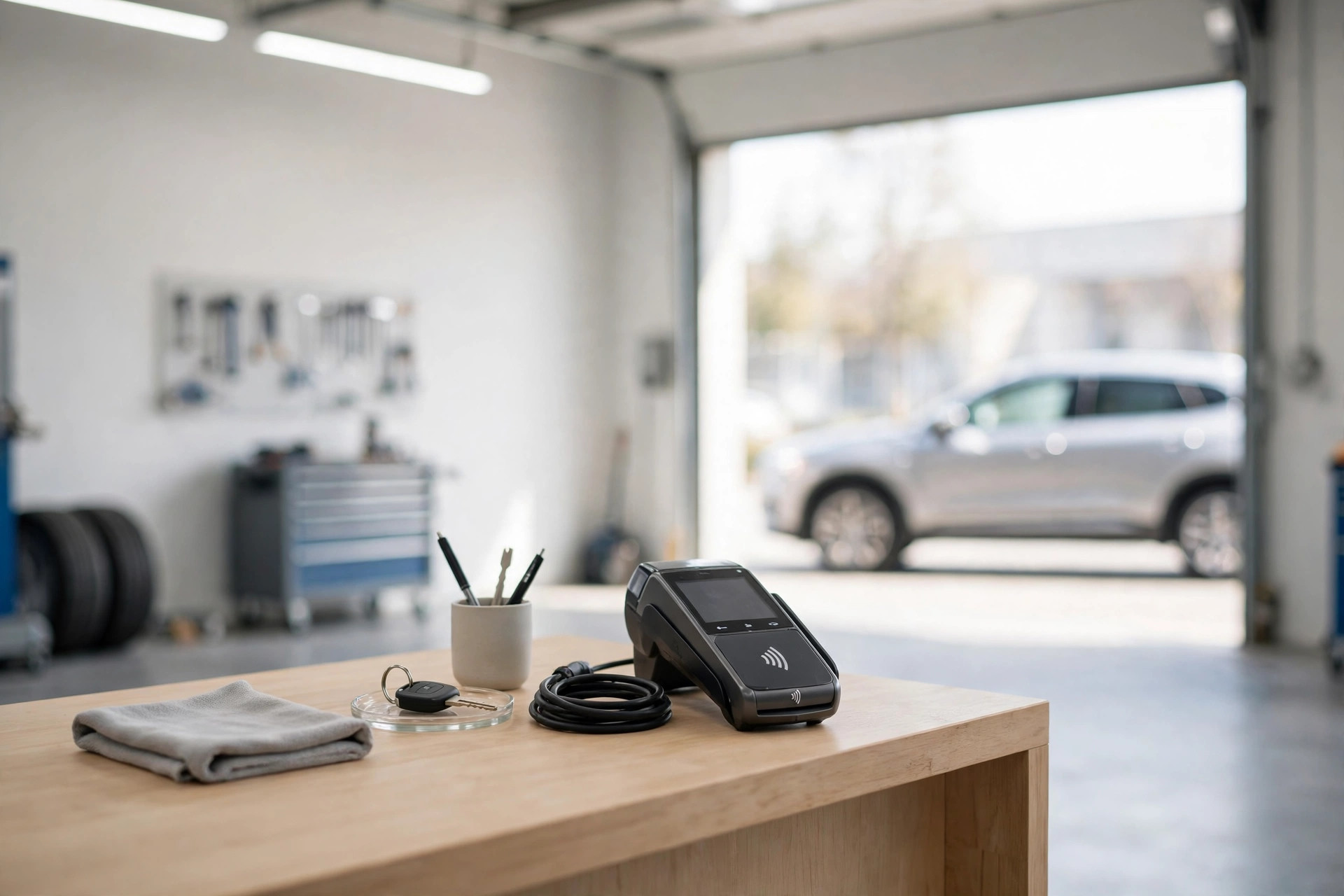
The average car repair invoice runs $500 to $600, and four-figure totals are routine. At those ticket sizes, a percentage fee stops being a nuisance and becomes a line item: on a traditional processor at 3.5%, a $500 repair keeps just $482.50 after fees. Shops that still think of processing as "about three percent" are underestimating what it costs them per bay, per month.
Why the $600 ticket changes the math
On small tickets, the per-transaction fee (ten or thirty cents) is the enemy. On $600 tickets, it's irrelevant, the percentage is everything. That flips the usual advice: flat-rate simplicity costs a shop far more than it costs a coffee bar, because the gap between wholesale (~1.5% on a typical mix) and a 2.65% flat rate applies to every one of those six hundred dollars.
Worked math: a shop at $80,000/month, flat-rate vs interchange-plus
The setup: $80,000/month in card sales, $600 average ticket (~133 transactions). Card mix: 60% standard credit, 25% premium/rewards, 15% Interac debit.
Flat-rate at 2.65% + $0.10/transaction: $80,000 × 2.65% = $2,120, plus 133 × $0.10 = $13. Total: ~$2,133/month (2.67% effective).
Interchange-plus at wholesale + 0.40% + $0.10/transaction: wholesale on the mix runs near 1.50% (~$1,200), markup 0.40% (~$320), per-transaction ~$13. Total: ~$1,533/month (1.92% effective).
The gap: ~$600/month, about $7,200 a year, on identical sales. At shop ticket sizes, half a point of rate is a phone call worth making: the per-transaction fee barely registers, so the entire decision is the percentage.
Canadian surcharging: the rules, the cap, and the Quebec exception
Since the class-action settlement, Canadian merchants may surcharge credit cards, and auto shops are among the likeliest to consider it. A CFIB survey found about 19% of merchant members would offset fees by surcharging, with business-to-business sellers (jobber to shop) more inclined than consumer-facing ones. But the rules are specific:
- Cap: 2.4%. The surcharge may not exceed 2.4% of the transaction, and never more than your actual cost of acceptance.
- Notice: 30 days. Mastercard requires advance notice to both Mastercard and your acquirer at least 30 days before you start.
- Disclosure everywhere. Signage at the entrance, at the checkout, on the receipt, and online if you take web payments.
- Credit only. No surcharges on Interac debit or prepaid cards.
- Not in Quebec. Quebec's consumer-protection law blocks surcharging, shops there must use other levers.
One honest caveat from the trade press: many shops that already "build the fee into pricing" are effectively charging every customer, including debit and cash payers, the credit-card price. Surcharging, done by the book, is arguably fairer than that.
Processor comparison with dated Canadian pricing
| Processor | Published Canadian pricing (checked) | Shop fit |
|---|---|---|
| Helcim | Interchange-plus, ~0.40% in-person margin (checked 2026-10-11) | Best value above ~$25k/month; invoicing for fleet accounts built in |
| Chase (via Scotiabank) | 2.45% in-person credit published (checked 2026-10-11) | Bank-backed flat-ish option; keyed rate 2.75% for phone payments |
| Square | 2.50% in-person credit, Canada (checked 2026-10-11) | Simple counter setup; no monthly fee; costly at shop volumes |
| Moneris | Flat rate from 2.65% + $0.10 (checked 2026-10-11) | Incumbent with deep shop penetration; ask for interchange-plus by quote |
What shop owners say: real merchant reviews
Square's review picture is consistent across aggregators: users praise the ease of setup and use, while recurring complaints cite difficulty reaching live support, slowdowns at high transaction counts, and fees cutting into margins as volume grows (nasdaq.com/articles/square-review). On Capterra, Square POS holds strong ease-of-use scores (~4.7/5 from 3,000+ reviews), but individual negative reviews flag the tail risk of any aggregator, withheld funds and painful account-resolution processes (capterra.co.nz/software/154907/square-point-of-sale). Moneris's Canadian Trustpilot reviews are polarized: helpful support reps on one side, merchants discovering higher-than-expected effective rates and equipment restocking fees on the other (ca.trustpilot.com/review/moneris.com).
The phone-payment and after-hours problem
Shops take cards over the phone for authorizations and after-hours pickups, and keyed-in rates run higher (Square Canada: 3.30% + 15¢ manually entered; Chase: 2.75% keyed). If a meaningful share of your volume is keyed, that line deserves its own comparison: a payment link or terminal-based tap usually beats keying the number in.
A note on steps: this is a fee-analysis guide with a rules checklist, not a repair procedure, the numbered surcharge rules above are the actionable part.
FAQ
Can my shop surcharge in Quebec?
No. Quebec's consumer-protection law prohibits credit-card surcharges. Quebec shops should lean on debit steering and interchange-plus pricing instead.
What's the maximum surcharge in Canada?
2.4% of the transaction, capped at your actual cost of acceptance, with 30 days' notice to the card brand and your acquirer, and signage at the entrance, checkout, receipt, and online.
At what volume does interchange-plus beat flat-rate for a shop?
With $600 tickets the crossover comes early, often around $20,000–$25,000/month, because the per-transaction fee is negligible and the percentage gap applies to big tickets.